IES or LDT
Select the format supported by the calculation workflow. Confirm that the filename corresponds to the exact luminaire, optic, output package, CCT, and electrical configuration.
Photometric Resources
Locate IES and LDT photometry, supporting electrical data, and specification guidance without confusing a file format with a finished project result.
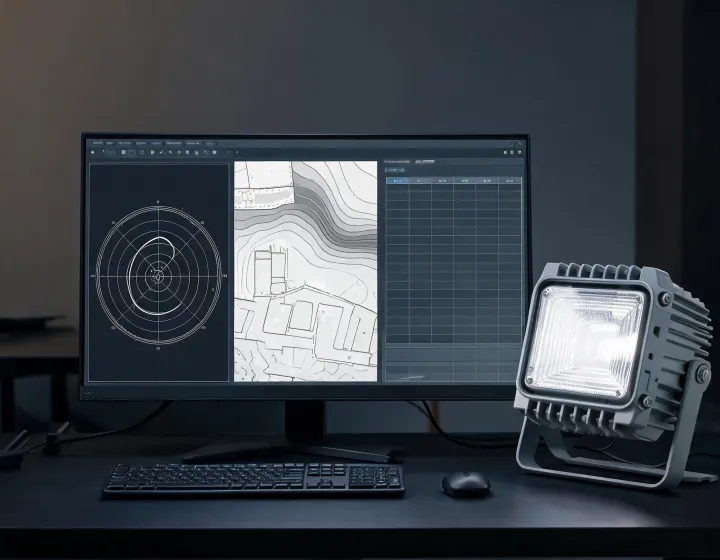
Select the format supported by the calculation workflow. Confirm that the filename corresponds to the exact luminaire, optic, output package, CCT, and electrical configuration.
Roadway, area, flood, wall, canopy, sports, downlight, linear, panel, and track applications require different review criteria and model geometry.
Photometry describes light distribution at the tested operating condition. Control compatibility, low-level behavior, sensor coverage, and sequences require separate evidence.
Pair files with a product schedule, revision date, applicable declarations, drawings, and substitution assumptions so the approval record remains traceable.
| Resource | What it can support | What it cannot establish alone |
|---|---|---|
| IES / LDT | Luminous intensity distribution, luminaire output, photometric geometry | Installed illuminance without site geometry, reflectance, maintenance, and aiming |
| LM-79 context | Laboratory measurement framework for complete LED luminaires | Performance of an untested variant or a future field installation |
| LM-80 / TM-21 | LED source lumen-maintenance data and projection methodology | Complete-luminaire warranty or service life under every thermal condition |
| IP / IK evidence | Tested assembly protection against ingress or impact | Protection after unapproved field modification or incorrect installation |
| UL / CE / RoHS | Defined safety, regulatory, or restricted-substance contexts | Interchangeable global approval across every configuration |
Include model, optic, output package, CCT, voltage, controls, mounting, application, and required revision date.
Request photometric resources