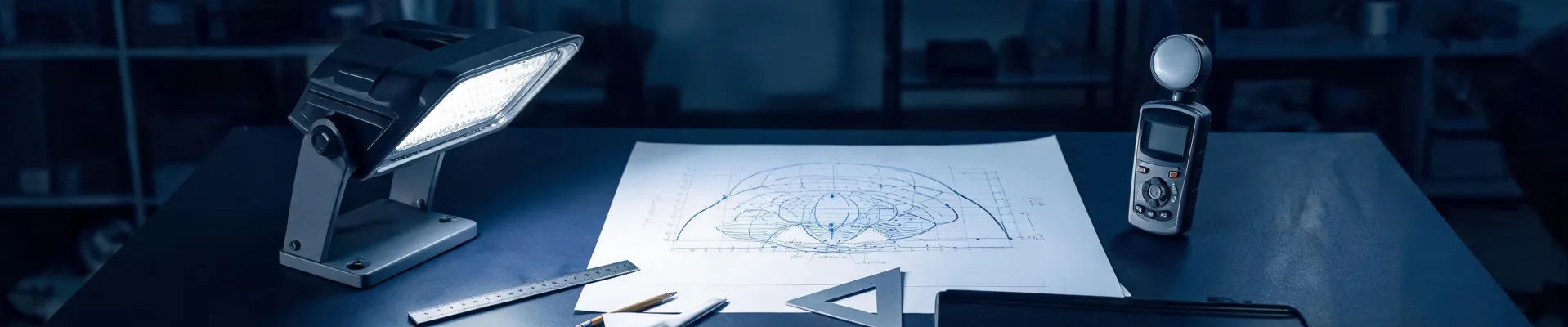
The only number worth trusting when you evaluate area light manufacturers is the landed cost on past invoices for comparable fixtures—not the unit price on the quote. On our last vendor switch, that gap was $42,000.
Quick context on who's writing this: I'm a procurement manager at a 120-person commercial facilities company. Our lighting and electrical budget runs roughly $400,000 annually. I've negotiated with 30+ vendors over seven years, and every invoice lands in our cost tracking system. When I first inherited the lighting category, I assumed the lowest quoted unit price was the winning bid. Two redos and one warranty dispute later, I stopped thinking that way.
This is the checklist I wish someone had handed me in year one.
Why This Checklist Looks Different From Most
I'm not a lighting designer. I'm not an electrical contractor. I'm the person who signs the PO and reconciles the spend at month-end. So the framework below is financially weighted—less about photometric curves, more about what actually shows up on the invoice.
What forced me to build it was a 2023 audit. I pulled two years of area light and downlight purchases, ranked them by unit price, then ranked the same orders by first-year landed cost. The two rankings differed by seven positions. Our third-cheapest quoted vendor ranked tenth on real cost.
We've since tested additional downlight supplier candidates, priced out a sports lighting private label run, and compared RAB commercial lighting quotes against two alternates for a ceiling light retrofit. Every time, the same pattern showed up: the quote is a starting point, and the real question is what isn't in it yet.
The Five Things I Actually Check
1. Invoice match the spec—or don't bother
Spec sheet first, price second. Not every fixture labeled "40W area light" performs the same. Efficacy, CCT, CRI, beam distribution, IP rating—these vary wildly between quotes that look identical on a spreadsheet, and the variations surface on the install and in the maintenance log.
I ask for LM-79 test reports (that's the photometric and electrical performance file) and LM-80 data if it exists (that's the LED chip lumen maintenance data). No LM-79, no conversation.
2. Certifications that I can verify myself
UL listings, DLC qualification, IP ratings—don't trust the badge on a product page. Ask for the certificate number and look it up. In 2022, we nearly took delivery on a batch that was advertised as DLC-listed but whose model number wasn't in the DLC database. That would've stalled the entire acceptance process.
3. Landed cost, not unit cost
The usual suspects for hidden cost:
- Freight and delivery method (a lot of area light quotes exclude freight, especially oversized fixtures)
- Change-order or re-tooling fees
- Warranty logistics—who pays return freight when a fixture fails under warranty?
- Small-batch premiums, which matter a lot on sports lighting private label runs
- Batch-to-batch color shift and the reorder cost that follows
I keep a simple TCO template with these line items pre-loaded. It isn't fancy. It just forces the conversation past the quote sheet.
4. OEM and private label fine print
If you're running a sports lighting private label program, or you want your own brand on a downlight line, ask three questions up front: what's the MOQ, who owns the tooling, and what happens to existing molds if the relationship ends?
One supplier told me the MOQ was "flexible." What he meant was that quantity could flex—not price. He didn't mention the $3,000 tooling charge until the third call. That kind of structure doesn't show up in a quote comparison.
5. How they treat the small order
I pay close attention to how a supplier handles a trial run. In early 2024, we placed a 12-fixture downlight order with a new vendor—under $2,000 total. Their response time, packaging quality, and documentation completeness on that order told us more than any factory tour would.
The vendors who take small orders seriously tend to become our large-order vendors. The ones who visibly resent the small order usually don't make it to year two.
When This Checklist Doesn't Apply
This framework fits companies spending roughly $30K to $500K annually on lighting—enough volume to negotiate terms, not yet large enough to justify a dedicated supply chain team.
If your annual lighting spend is under $50K, put the energy into validating trial-order quality rather than chasing price. If you're commissioning fully custom work—architectural facades, large outdoor sports lighting with non-standard photometrics—you'll need to layer design verification and third-party testing on top of everything above.
One more caveat: this is written for new vendor evaluation. Switching away from a supplier you've used for years is a different calculation. It's not purely about cost—it's about replacement risk, delivery reliability, and how much institutional knowledge walks out the door with them.
Clara Whitmore is a lighting photometry and LED source analyst specializing in bulbs, tubes, strips, panels, and integrated luminaires. She interprets IES LM-79 measurements and TM-30 color rendition data through luminous flux, efficacy, intensity distribution, CCT, chromaticity, fidelity, and gamut metrics. She writes evidence-led comparisons for specifiers selecting source formats and luminaires for commercial interiors, industrial spaces, or horticultural systems where measured optical and color performance matter.