For 11 years, I've worked in specification support at RAB Lighting. That means I'm the one taking the call when a commercial lighting order has gone sideways. The wall lights show up with the wrong voltage. The ceiling light on the submittal doesn't match what actually arrived. An inspector walks the job and flags 40 fixtures because they're not rated for the location they're in. And somewhere in the background, a deadline is doing what deadlines do: getting closer.
I've handled more than 200 of these urgent requests, and here's the pattern I keep coming back to: the emergency isn't the beginning of the story. It's just the part where the problem finally becomes visible. The actual mistake usually happened weeks earlier, when someone evaluated a wall light supplier or a street light manufacturer on the wrong things.
That's what I want to dig into here. Not how to survive a rush order, but what keeps causing these rush orders in the first place—and how to evaluate a lighting manufacturer so you don't end up making that phone call.
What Actually Goes Wrong Before the Emergency Call
When a deadline is close, the obvious villain appears to be delivery time. But in my experience, delivery is rarely the real issue. Most manufacturers can build a fixture. The problem is that the wrong fixture gets built, or the right fixture gets built with the wrong options, and nobody notices until it's too late.
It was specified by category, not by performance
Here's a sentence I hear all the time: “We just need commercial wall lights.” It sounds like a specification. It isn't one. A wall light can be a decorative sconce for a hotel entrance or a rugged wall pack for a parking garage. It can be 120V or 277V. It can have a photocell built in, or it can be tied to a lighting control system. It can be rated for dry locations only, or it can be marked “Suitable for Wet Locations” and stand up to direct rain. Those aren't style choices—they're performance requirements.
What I mean is this: the buying process usually starts with a category (“wall light” or “ceiling light”) and a price range, but it should start with the conditions the fixture will live in and the job it needs to do. What's the mounting height? Is it exposed to weather? What light distribution does the space need? Is there a control system in place? Are there code or energy requirements? If those questions go unanswered, the order becomes a lottery ticket. And the drawing date is the deadline.
This is why a wall light catalog, no matter how complete, is only as useful as the person using it. A catalog that filters by voltage, mounting, photometry, wet location, and control options is an engineering tool. A catalog that just shows pretty photos is a brochure. When you're evaluating a potential supplier, ask yourself which type of catalog you're looking at.
“Commercial grade” isn't a certification
I can't count how many times I've asked a caller whether a fixture needs to be wet-location rated, and heard the reply: “It's commercial grade.”
Here's the uncomfortable truth: “commercial grade” is a marketing phrase. It doesn't appear on a UL listing. It doesn't show up in the DesignLights Consortium (DLC) Qualified Products List. It doesn't mean the fixture has been tested, certified, or approved for anything. It's an adjective, not evidence.
I once spent 45 minutes helping a contractor replace 32 exterior wall sconces along open stairwells and a loading dock, where rain hits them directly. That's a wet location. The fixture that showed up on the job was labeled for damp locations—fine under a roof overhang, but not fully exposed to weather. The person who ordered them said “commercial-grade exterior lights,” and their supplier heard “lowest price with an outdoor-looking housing.” Same words. Different meanings. And the inspector caught it.
UL's Product iQ database (ul.com) and the DesignLights Consortium's qualified products list (designlights.org) are both public. Check them. If you find no listing for the exact model number you're buying, that's valuable information—and it's much cheaper to learn that before the fixtures arrive than after they're installed.
Street lighting has a second customer: the municipality
Street lights deserve special attention because the evaluation process includes a second audience that most people don't think about. If you buy a ceiling light for a private office, final acceptance is usually between you, your client, and the inspector applying code. If you buy street lights for a city, the design gets reviewed by a municipal engineer or a lighting consultant, who runs photometric calculations to verify light levels and uniformity. They care about whether the proposed fixture actually produces the required distribution. You need photometric data to prove it.
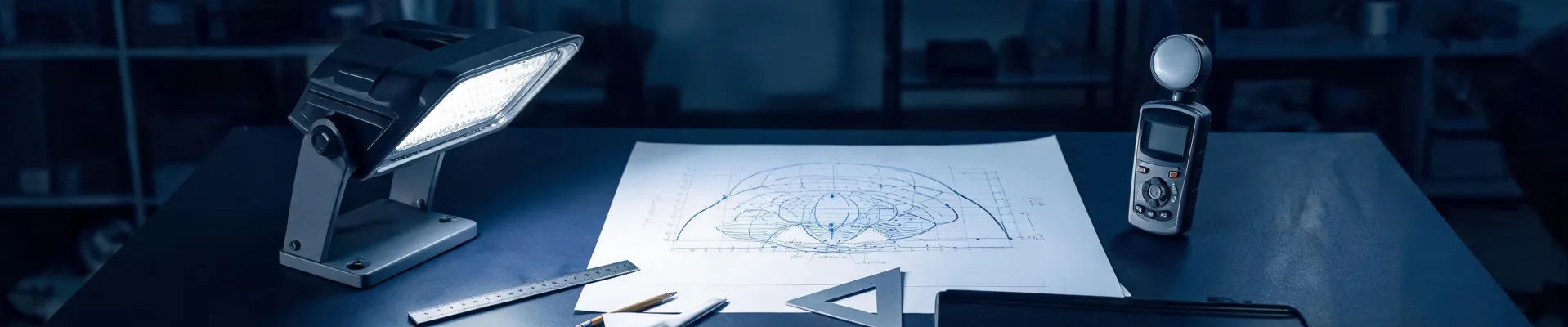
This is exactly where the “cheapest quote” trap lives. When you evaluate street lighting manufacturers, don't stop at lumens per watt and price per piece. Ask to see photometric files—in .ies format—that you can load into lighting calculation software. If the manufacturer can produce files that show the right distribution and meet the city's requirements, you have a workable project. If they can only offer a glossy datasheet with no real numbers, you have a schedule risk.
The best way to think about it: street lighting is bought on evidence, not promises. A legitimate street light manufacturer keeps its IES files, LM-80 data, driver specs, and surge protection details ready. If you have to fight to get basic technical data during evaluation, imagine how much harder it will be when the project is already behind.
The Price of Finding Out Too Late
Let's talk about cost, because “it's cheaper” is usually what starts these emergencies.
I've made this mistake myself. Earlier in my career, working on the distribution side, I approved an order of 50 LED ceiling lights for a church fellowship hall. The quote came in about $2,000 below another manufacturer's, and the spec sheet said “dimmable.” It didn't say how dim. After installation, the lights couldn't go low enough for presentations, and we had to replace drivers with a lift rental and an electrician on site. I still kick myself for not asking for a dimming compatibility report before I approved the order. “Dimmable” turned out to be an adjective, not a specification.
There's a reason this matters under deadline. I've seen a project where getting replacement wall packs to the site in three days cost about $700 in emergency freight. The delay they were trying to avoid carried a $9,000 penalty clause. When you write it out like that, the choice seems obvious. But in the moment, the overtime freight feels like the expensive option, while the penalty is abstract. It isn't abstract. Neither are the extended equipment rentals, the rescheduled inspections, or the client who stops returning your calls.
Speed is not what you're paying for in an emergency. You're paying for certainty. The manufacturer who says “that should probably be okay” is more expensive than the one who says “here's the specification, here's the certification, and here's the date we'll ship.” Certainty removes the gamble, and in a lighting project, a gamble is never actually cheaper.
How to Evaluate Street Lighting Manufacturers in Four Checks
If you're short on time and need a defensible way to assess a street light manufacturer—or any lighting supplier—this four-step sequence works.
- Can they verify their certifications? Ask whether the exact model number is listed. Check public databases if you need to. A manufacturer that can't point you to a UL listing, a wet-location marking, or a DLC listing is asking you to trust a label they created themselves.
- Do they publish photometric data? For any outdoor area or street light, an .ies file should be available without a phone call. The same logic applies to wall lights and ceiling lights if the design depends on distribution. If you have to wait three days for basic photometry, you're not evaluating a manufacturer—you're auditioning a bottleneck.
- Can they answer technical questions with specifics? Call them and ask: “What's the input voltage range? What driver is in this fixture? Is it suitable for wet location? Does the photometry change with the shield?” A real application engineer can answer in minutes. A sales script cannot.
- Will they commit to a ship date and stand behind it? Ask what happens if the date slips. Ask if they offer expedited options. The answer tells you whether they treat deadlines as commitments or as suggestions.
Those four checks are also the standard I'd want applied to RAB Lighting. When you search for RAB commercial lighting and land in the ceiling light or wall light section, the certifications, photometric files, and technical details should be part of the page—not buried behind a request form. The RAB Lighting ceiling light lineup and the wall light catalog are designed to give specifiers what they need before they ever talk to a person. If you're evaluating us as a wall light supplier or a street light manufacturer, evaluate us the same way: look for the evidence.
The right manufacturer won't always have the lowest price. But the right manufacturer will keep your project out of the emergency lane. In my 11 years of taking those calls, that's worth more than any discount.

Clara Whitmore is a lighting photometry and LED source analyst specializing in bulbs, tubes, strips, panels, and integrated luminaires. She interprets IES LM-79 measurements and TM-30 color rendition data through luminous flux, efficacy, intensity distribution, CCT, chromaticity, fidelity, and gamut metrics. She writes evidence-led comparisons for specifiers selecting source formats and luminaires for commercial interiors, industrial spaces, or horticultural systems where measured optical and color performance matter.