RAB Lighting Is the Right Call for Some Projects—and the Wrong Call for Others
I've been buying lighting for our facilities since 2019. In that time, I've sourced everything from a four-pack of ceiling lights for a tiny satellite office to a 47-fixture area lighting package for a warehouse parking lot. Here's what I actually think after going through this a few times:
RAB Lighting makes sense when you're specifying commercial-grade fixtures in volume and you need the paperwork to back it up. It doesn't make sense when you're just replacing a couple of ceiling lights in a small office.
That sounds obvious. It isn't. I've watched two colleagues overbuy for tiny projects and one under-buy for a serious one. Both directions cost real money.
Let me show you what I mean.
Argument 1: The Spec Sheet Is the Product
When I first started handling our facilities purchasing, I did what most admin buyers do—I compared unit prices. The cheap option looked like the smart option. Then the electrical contractor told me our parking area lights were pulling more wattage than the spec sheet claimed, and the discrepancy mattered enough that our energy rebate application got flagged.
That was a $1,800 lesson in why commercial lighting isn't a commodity.
What I've learned from working with RAB on the last three orders is that the value isn't the lumens-per-watt number on the box. It's the documentation behind it. When we sourced area lights for the 2024 warehouse lot project, I needed:
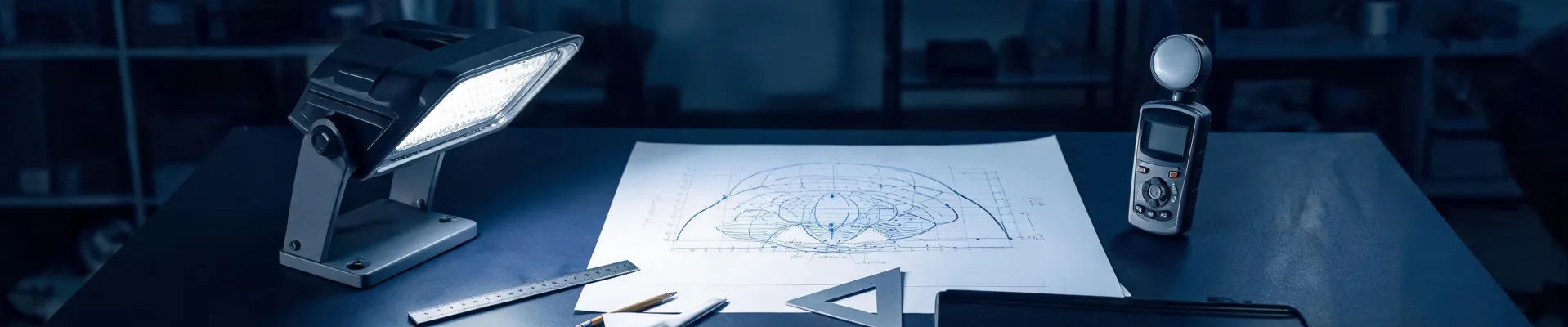
- Photometric files (IES) for our lighting consultant
- DLC listing confirmation for the utility rebate
- Wattage and lumen output verified against the printed spec sheet—not just the marketing page
RAB delivered all three without me having to escalate. That's not a marketing claim. That's me comparing it against two other quotes where I had to chase the distributor for a week to get an IES file that actually matched the fixture we ordered.
What 'Specification-Grade' Actually Means in Practice
It means if you're a facility manager or a contractor bidding on a job, the fixture has to survive inspection. A standard residential flood light from a big-box store isn't going to pass commercial code requirements in most jurisdictions—not because it's unsafe, but because it's not listed for the application.
RAB's portfolio covers a wide range: flood lights, ceiling lights, downlights, area lights, panels, track lights, sports lighting, wall packs, street lights, linear fixtures. The breadth matters because it means one vendor relationship can cover multiple scopes of work. When we consolidated our vendor list in 2023, that single-source advantage saved my team roughly four hours a month in coordination (and honestly, those hours add up).
Argument 2: Bulk Sourcing Changes the Math
Here's the part most reviews skip. If you're buying one or two fixtures, you're shopping retail. If you're buying 20+, you're shopping wholesale, and the conversation is completely different.
RAB offers OEM and private-label options for distributors and larger buyers. I've used their wholesale channel for two projects—a 2023 office refresh (36 ceiling panels) and the 2024 parking lot job (47 area lights). In both cases, the per-unit price dropped meaningfully once we crossed their wholesale threshold, and the lead times were quoted with dates I could actually put in a project plan.
What I appreciated most wasn't the discount. It was that they provided OEM labeling options without making it a bureaucratic headache. Our distributor handled most of it, but the RAB side responded within 48 hours both times. Compare that to a different vendor who took 9 days to confirm a custom LED panel order and then shipped the wrong CCT.
The Mistake I Almost Made
When I signed off on the 2023 panel order, I second-guessed myself for two weeks. What if the 4000K color temperature looked too clinical in the open office? What if the dimming compatibility with our existing system was off? The fixtures arrived, the electrician installed the first row, and everything matched the sample we'd approved. I didn't fully relax until the final punchlist was signed off.
That anxiety wasn't about RAB specifically. It's about being the person who signs the PO and then has to live with the result.
Argument 3: The Real Differentiator Isn't the Fixture—It's the Paperwork
This is the counterintuitive part, and it's the one I'd tell any facilities buyer to pay attention to.
Your electrician can install almost anything. Your inspector can't approve almost anything. What separates a smooth project from a stalled one is whether the documentation chain holds up when someone official asks for it.
In our 2024 warehouse project, the county inspector asked for proof that the exterior area lights were rated for the ambient temperature range we have here in winter. Our RAB distributor pulled the spec documentation within a day. The alternative fixture we'd initially considered—a cheaper import—didn't have that data available at all. That alone would have delayed our certificate of occupancy.
The cost difference between those two options was about 12% per fixture. The cost of a delayed CO was a lot more than 12%.
So Who Shouldn't Buy RAB?
I'll be direct, because I've seen this mistake happen.
If you're buying fewer than 5 fixtures for a non-commercial application, RAB is probably overkill. A small office that needs three replacement ceiling lights doesn't need specification-grade anything. You're paying for certifications, documentation, and commercial compliance that no one will ever ask you about. A standard commercial-grade fixture from a local supplier will do the job for less.
If you're on a tight timeline and can't wait for a wholesale lead time, check local distributor stock first. RAB's wholesale channel typically quotes 2-4 weeks depending on SKU and volume. That's normal for this industry, but it's not same-day. If you need something tomorrow, you need a different plan.
If your project is residential—even a large custom home—this isn't the right catalog. The fixtures are built for commercial applications, and the sizing won't match residential aesthetics. Wrong tool, wrong job.
And if your priority is absolute lowest unit cost with no compliance or rebate requirements? There are cheaper options. You just won't have the documentation trail when you need it.
The 80/20 Rule I Actually Use
After six years and roughly $140K in cumulative lighting spend, here's how I decide:
- Commercial project with inspection or rebate requirements? Go with a specification-grade brand like RAB. The documentation is the product.
- Bulk order (20+) with a 3-6 week timeline? RAB's wholesale/OEM channel is competitive and the lead time is predictable.
- Small order, no compliance angle? Buy locally and save the process overhead.
- Residential or aesthetic-driven? Different catalog, different conversation.
None of this is about brand loyalty. I've recommended RAB for three projects and talked a colleague out of it for one. The question isn't 'is RAB good?'—it's 'is RAB right for this specific job?'
Most of the time in commercial settings, it is. When it isn't, I'd rather say so upfront than have someone else learn the way I did.

Clara Whitmore is a lighting photometry and LED source analyst specializing in bulbs, tubes, strips, panels, and integrated luminaires. She interprets IES LM-79 measurements and TM-30 color rendition data through luminous flux, efficacy, intensity distribution, CCT, chromaticity, fidelity, and gamut metrics. She writes evidence-led comparisons for specifiers selecting source formats and luminaires for commercial interiors, industrial spaces, or horticultural systems where measured optical and color performance matter.