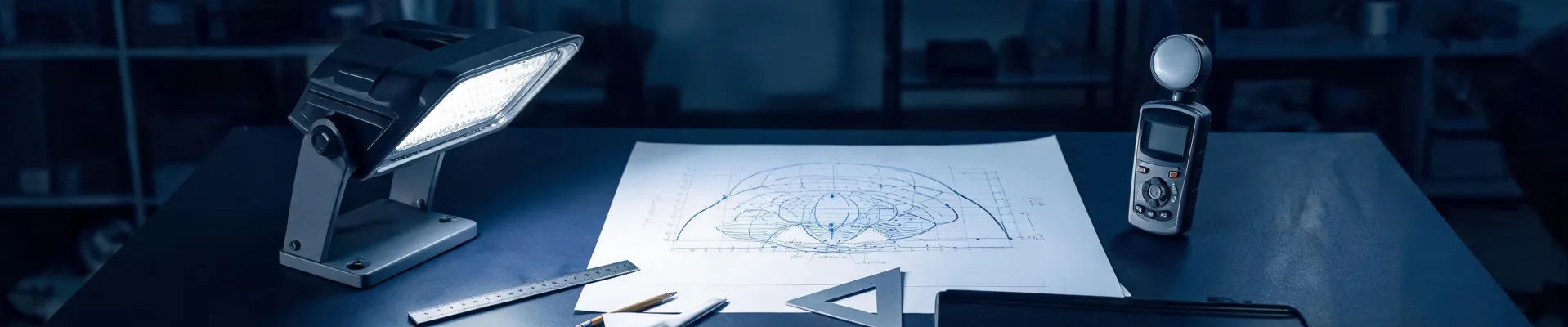
In March 2024, we rejected a batch of 400 LED flood lights. The vendor's quote was 22% below the next bid. The sales rep's demo unit looked solid. But when we tested the actual batch against our specification, the color temperature drifted by 350K across fixtures. Some were 4300K, some were 3850K. On a single pole, that's noticeable. On a parking lot, it looks broken.
That rejection cost us three weeks and a $22,000 redo. The vendor did replace the fixtures at their cost, but we ate the labor, the crane rental, and the customer's patience. That's the kind of problem that doesn't show up in a unit price comparison.
I work in quality and brand compliance for a commercial lighting company. I review every delivery before it goes to a customer—roughly 200+ unique products a year. I've been doing this for over four years, and the same pattern keeps repeating: buyers assume that if two fixtures have similar specs on paper, the cheaper one is a smarter buy.
The Problem Isn't Price—It's Spec Drift
It's tempting to think you can compare LED fixtures by looking at lumens, wattage, and CCT on a datasheet. But identical specs from different factories can result in wildly different outcomes in the field.
The phrase I hear constantly is: “It's all the same LEDs anyway.” It's not. The LED chips may come from the same Korean or Taiwanese foundries, but how they're sorted, binned, driven, and thermally managed makes all the difference.
Let me walk you through what actually happens when a manufacturer cuts corners, because it's rarely about the visible components.
Bin Sorting and Color Consistency
A spec might call for 4000K. But LED chips naturally vary—some come off the line at 3800K, some at 4200K. Reputable manufacturers bin-sort chips into narrow ranges before assembly. Others skip that step to save money.
Roughly 2% to 5% of the LED fixtures we test fail CCT consistency claims—or rather, the consistency within a single shipment. The spec says 4000K, and the fixtures measure anywhere from 3900K to 4200K. It may not show up in a single unit inspection.
Most buyers don't test for this. We do, because we've been burned.
Driver Quality and Thermal Management
The driver is the heart of an LED fixture. A cheap driver can fail at 15,000 hours. I've seen drivers that were rated IP66 fail in the first six months because the gasket wasn't seated properly during assembly.
The 'always buy by specs' advice ignores the fact that not all specs are true. Some manufacturers list their drivers as 'equivalent to' established brands, but the actual component inside is a white-label version with unknown reliability.
Why Misconceptions About LEDs Are Costing You Thousands
There's a legacy belief that "the more you pay for lighting, the more you're paying for the brand name." That thinking comes from an era when lighting was a commodity. Today, LED fixtures are engineered products with thermal management, optical design, and electronic drivers—the differences are measurable.
Here's what I wish every buyer understood: the cost of a failed lighting delivery isn't the fixture cost—it's the labor, the downtime, and the deadline.
The Real Cost Is the Missed Deadline
I've seen it play out more times than I can count. A project manager orders 200 floodlights from a low-cost supplier because the fixtures are $45 cheaper each. That's a $9,000 savings—which seems like a win until the fixtures fail QC and the whole project is delayed by a week.
The upside of that savings was $9,000. The risk was delaying a grand opening, losing a permit window, or paying a crew to stand around while replacements ship. I kept asking myself: is $9,000 worth potentially losing a client's trust?
In one 2023 project, the customer needed 150 ceiling lights for a retail renovation. They'd already committed to a store opening date. The fixtures arrived late and 10% of them were dead on arrival. The contractor had to work overtime to swap them out, and the store still opened a week late. I don't know the exact penalty—I'd have to ask—but I do know it wasn't worth the 15% price difference.
Every spreadsheet analysis pointed to the cheaper vendor. Something felt off about their responsiveness during the sample stage. Turns out the slow replies were a preview of slow delivery and worse QC.
Wholesale Doesn't Mean Substandard
There's a misconception that you can't get both wholesale pricing and spec-grade quality. That's where an OEM supplier differs from a commodity trader.
A good outdoor lighting manufacturer will:
- Provide LM-80 test data and TM-21 lifetime projections
- Offer consistent binning and documented color tolerance (typically within 3-step MacAdam ellipse)
- Perform in-house thermal testing and surge protection validation
- Stand behind written specifications with an actual factory QC process
To be fair, budget manufacturers have improved in the last few years. Some can deliver decent fixtures for straightforward interior applications. But when you're spec'ing for outdoor environments—extreme temperatures, moisture, vibration—the margin for error narrows quickly.
What a Quality-First Process Looks Like
After getting burned twice by 'probably reliable' vendors, we changed how we evaluate lighting suppliers. The process is straightforward, and it doesn't require being a lighting engineer.
Demand Data, Not Demos
Anyone can polish a demo unit. We now require:
- Photometric files (IES/LDT) created by an independent lab, not the factory
- Test reports for the exact model, not a similar model
- A written warranty policy with specific terms on driver replacement
- Confirmation that the factory has ISO 9001 or equivalent process documentation
Ask About Binning and Incoming Inspection
One question changes everything: "Do you test incoming LED batches for CCT and flux before assembly?"
Manufacturers with proper QC processes will say yes and explain their thresholds. Others will say "we trust our supplier." That's a red flag.
Build in a Buffer for the Schedule
Even with a solid supplier, we now budget extra time for a random inspection of the actual delivery—not just the pre-shipment sample. It's a small cost compared to the risk of a rejected batch in the field.
Why We End Up Specifying RAB Lighting
I'll be honest: I'm not a salesperson, and RAB isn't the only spec-grade manufacturer out there. But they're the one we've consistently come back to for projects where compliance and delivery dates both matter.
RAB Lighting is a commercial and outdoor LED manufacturer that understands the OEM side of the business. They produce flood lights, ceiling lights, downlights, area lights, and sports lighting that are meant to match a real spec—not just a datasheet.
What I appreciate from a QC perspective:
- They publish photometric data across their catalog, so I can review performance before requesting a sample.
- Their fixtures consistently stay within CCT tolerance across a single order—our tests show 1–2 step MacAdam ellipse behavior in most RAB products.
- They offer private label and wholesale options with clear compliance documentation. For us, that's the difference between fighting a vendor for paperwork and getting a complete package upfront.
We've also specified RAB fixtures for retrofit projects where the ceiling light layout needed to match existing cuts—their variety of form factors made it possible without custom tooling.
The moment I knew they were doing something right was during a 2024 warehouse project. We ordered 1,200 RAB ceiling lights. The delivery arrived in two phases. The first batch measured 4025K average. The second batch? 4013K. That's the kind of consistency that makes a quality manager's job boring in the best way.
Rush Orders and the Value of Certainty
In January 2025, we had a customer request 300 units in ten days—a timeline we honestly didn't think was possible. The expedite fee was real, but the alternative was missing a grand opening. We paid for guaranteed delivery, and RAB hit the date.
That's the part people forget about 'cheapest plus buffer' thinking: delay costs about $2,500 per day on a construction project of any meaningful size, once you factor in the crew and carrying cost. A few weeks of buffer can easily erase the savings from choosing a risky vendor.
The Bottom Line
The goal isn't to find the perfect vendor. It's to find one that's truthful about what they're shipping and capable of proving it before the deadline arrives.
If you're ordering wholesale flood lights or looking at spotlight cost guides, your first question shouldn't be "what's the price per watt?" It should be "what data can you show me proving this fixture will meet spec consistently, at scale, under real conditions?"
Cheap lights have a way of getting expensive at the worst possible moment. The companies that treat quality as something to be tested rather than assumed are the ones that survive the schedule intact.

Clara Whitmore is a lighting photometry and LED source analyst specializing in bulbs, tubes, strips, panels, and integrated luminaires. She interprets IES LM-79 measurements and TM-30 color rendition data through luminous flux, efficacy, intensity distribution, CCT, chromaticity, fidelity, and gamut metrics. She writes evidence-led comparisons for specifiers selecting source formats and luminaires for commercial interiors, industrial spaces, or horticultural systems where measured optical and color performance matter.