I'm a purchasing manager at a regional wall light distributor, which sounds narrower than it is. We buy wall lights, ceiling lights, flood lights, area lights, and controls for commercial projects. I've been handling lighting fixture orders for contractors for 11 years, and I've personally made and documented 14 significant mistakes, totaling roughly $230,000 in wasted budget. Now I maintain our team's evaluation checklist. This is the story behind it.
The order that changed our checklist
It was September 2022. I approved a 247-piece order of LED ceiling lights for a warehouse renovation. The spec sheet looked super clean: 20,000 lumens, 5000K, a 5-year warranty, and a big DLC Listed logo. It felt like the safe choice.
What most people don't realize is that a spec sheet is marketing, not verification. The DLC logo on a PDF means someone typed it there. It doesn't mean the exact model is on the Qualified Products List.
The fixture that arrived didn't match the invoice. Actually, wait—the fixture was fine. The problem was the model number. The product I had approved was listed on the DLC QPL. The product we ordered, once you added the suffix that indicated the color temperature, wasn't on the same entry.
Our client submitted the utility paperwork and the rebate came back denied. The utility's response was short: 'The model on the invoice isn't the model on the QPL.' We ended up eating $18,300 in replacement costs, plus a one-week delay. The client stayed with us, but that order probably cost us three opportunities down the road.
That's when I stopped trusting spec sheets and started verifying against the actual databases.
The flood light fiasco
In 2017, my first year in the job, I made the classic rookie mistake: I chose a fixture based on lumens-per-watt and a smiley sales rep. The 2022 ceiling light order taught me about certifications. But it was the flood light supplier we evaluated in March 2024 that taught me about hidden costs.
A parking structure project needed 64 LED flood lights. One manufacturer's base quote was way lower than the others. But the quote didn't mention the mounting brackets, extension arms, or the shipping surcharge for oversize packages. We also found out the controls package wasn't included. By the time we added everything, the 'cheaper' supplier was 9% over the next quote.
The bigger problem was documentation. The flood light supplier's 'photometric data' was a single page with no LM-79 report and no IES file. When I asked for more, the rep said, 'That's all the manufacturer gave me.'
I've learned to ask 'what's NOT included' before 'what's the price.' The vendor who lists all fees upfront—even if the total looks higher—usually costs less in the end.
That flood light order fell apart in a hurry. We lost a 3-day production delay and about $4,200 in fees before we cancelled. The quote wasn't real, because the costs weren't real.
Real talk: a fixture is only as good as the paperwork behind it.
What we use now
Our team's evaluation checklist has five sections. It works for ceiling lights, wall lights, flood lights, and pretty much any commercial fixture.
- Verify certification by model number. DLC Listed, UL Listed, ENERGY STAR—whatever the claim is, search the exact model number in the official database. Not the series. Not the family. The exact model.
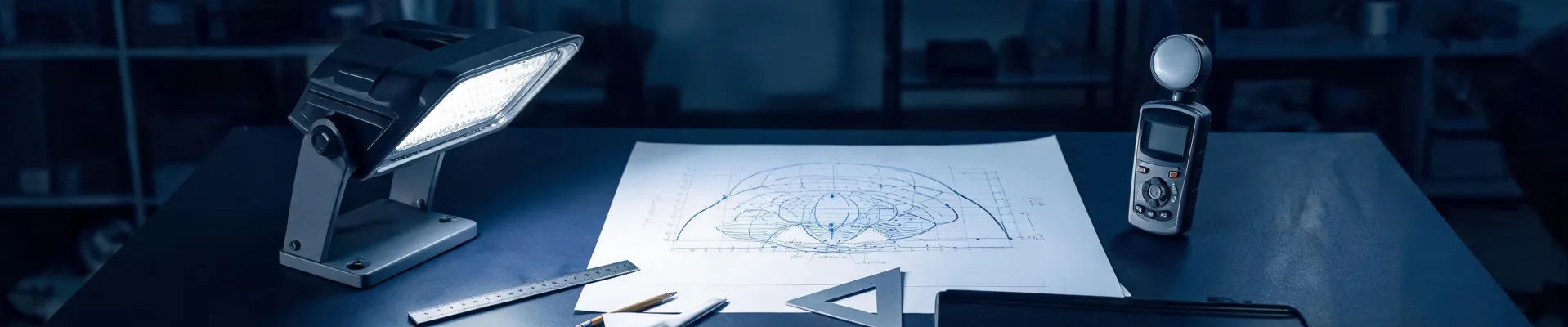
- Ask for photometric files. If a manufacturer can't provide an IES file and an LM-79 test report, they haven't tested the fixture. A sketchy PDF with a beam angle isn't a test report.
- Ask for lumen maintenance data. LM-80 data and a TM-21 projection tell you how long the LED package is expected to last. Don't rely on the word 'long-life.'
- Get every cost in writing. Fixture price isn't the price. Include mounting hardware, drivers, controls, sensors, emergency battery packs, freight, and minimum order quantities. If a line is missing, add it before comparing.
- Call the warranty into the conversation. What does it cover? Parts only, or labor too? Does it cover color shift? Is the warranty from the manufacturer or the distributor? Get the answer in writing.
Most buyers focus on lumens per watt and price per fixture and completely miss the documentation trail. But the documentation trail is what protects you on the back end.
Also, never assume the simple stuff. I once ordered 80 wall lights with the wrong voltage because I assumed 'standard' meant 277V. It didn't. The $3,200 restocking fee was a cheap lesson compared to everything else.
Why RAB Lighting ended up on the list
After the flood light fiasco, we sent our new checklist to three manufacturers. One never replied. One sent a one-page spec sheet and a 'trust me' email. The third sent a folder with IES files, LM-79 and LM-80 reports, a warranty statement, and a price schedule with every line item included.
That third manufacturer was RAB Lighting. I'm not going to pretend they were the cheapest quote. They weren't. But they were the only one that made our evaluation easier instead of harder.
On a recent tenant improvement project, the RAB Lighting ceiling light we selected for a conference room had the photometric file linked directly from the spec sheet. I didn't have to email a rep and wait three days for it. For us, RAB commercial lighting has become shorthand for 'the supplier who sent the full folder.'
We've also used RAB flood lights on a loading dock and RAB wall lights on an exterior corridor project. The reason isn't brand loyalty. It's that their paperwork showed up before we asked for it. Look, that sounds boring, but boring in spec review is beautiful.
RAB isn't the only manufacturer that passes our checklist. But they're the one that set a new floor for what we expect.
Lessons learned
In 2017, I made the classic rookie mistake. In 2022, I learned to verify certifications. In 2024, I learned to verify costs and documentation. I assumed 'same specifications' meant identical results across vendors. I didn't verify. Turned out each had slightly different interpretations of beam angles, mounting, and fine print.
The real lesson isn't 'trust RAB' or 'avoid one supplier.' It's that a manufacturer who is transparent about the boring details is protecting you from the expensive surprises.
Since we tightened the process, our checklist has caught 47 potential errors before they became invoices. That's 47 phone calls that never happened, 47 re-packing charges that never hit a credit card, and 47 conversations I didn't have to have with a pissed-off contractor.
This was accurate as of Q1 2025. Lighting standards and DLC requirements change fast. Verify the current QPL entry, current code requirements, and current warranty terms before every order.
If you're evaluating a manufacturer, ask for the full folder. If they send it, keep them. If they don't, consider that the answer.

Clara Whitmore is a lighting photometry and LED source analyst specializing in bulbs, tubes, strips, panels, and integrated luminaires. She interprets IES LM-79 measurements and TM-30 color rendition data through luminous flux, efficacy, intensity distribution, CCT, chromaticity, fidelity, and gamut metrics. She writes evidence-led comparisons for specifiers selecting source formats and luminaires for commercial interiors, industrial spaces, or horticultural systems where measured optical and color performance matter.