-
Step 1: Verify Compliance Certifications Before You Compare Prices
-
Step 2: Demand Photometric Files — Not Marketing Brochures
-
Step 3: Calculate Total Cost of Ownership, Not Unit Price
-
Step 4: Outdoor Lighting Private Label — Know What You're Signing
-
Step 5: Lead Times and Delivery Guarantees — Certainty Is Worth Paying For
-
Step 6: Read the Warranty — The Exclusions Are the Story
-
Step 7: Ask for References — and Call Them
-
Common Mistakes I've Seen (and Made)
-
Price Context (as of January 2025)
If you're buying sports lighting for a commercial project — as a contractor, distributor, or facility manager — you already know the stakes. Once those poles go in the ground, swapping fixtures is expensive and painfully visible. This checklist is for evaluating sports lighting manufacturers before you sign the purchase order, not after.
I've managed procurement for a facility group for six years, tracking roughly $180,000 in annual lighting spend across every invoice we've processed. I've made mistakes, paid for them, and turned those mistakes into this checklist. Here's what it covers: compliance verification, photometric data, total cost of ownership, private label options, lead times, warranty traps, and reference checks. Seven steps, in that order.
Step 1: Verify Compliance Certifications Before You Compare Prices
This has to happen first — not after you've fallen in love with a photometric sheet. Sports lighting compliance requirements are the one place where a small documentation gap becomes a big construction problem.
At minimum, your manufacturer should provide:
- UL 1598 / UL 8750 listing — safety certification for the luminaire and LED equipment. Check the public UL Product IQ database; don't rely on the data sheet.
- DLC listing — if you're counting on utility rebates. "DLC-ready" and "DLC-listed" are not the same thing.
- FCC Part 15 compliance — because nobody wants RF interference near a scoreboard or broadcast area.
- IP rating — for outdoor sports lighting, IP65 or IP66 is the practical baseline. Below that, you're rolling the dice on moisture ingress.
- Surge protection — sports fields mean long cable runs and exposed locations. Look for ANSI/IEEE C62.41-compliant surge protection, either built in or specified alongside the fixture.
Here's a trap I fell into: I asked for "DLC-listed" fixtures. The vendor confirmed they were "DLC-qualified." Quiet difference, right? The fixture worked fine, but the listing category didn't match the application, so the utility rebate got rejected. A twenty-minute search in the public DLC database would have caught it.
Honestly, I'm not sure why some manufacturers blur that line. My best guess is they want to keep momentum on a sale while qualification is still pending. But "ready" doesn't pay the rebate invoice.
The one brand that has never made me chase down a listing document is RAB Lighting. In 14 orders across six years, their spec sheets have matched the public databases every time. That's rare enough to note.
Step 2: Demand Photometric Files — Not Marketing Brochures
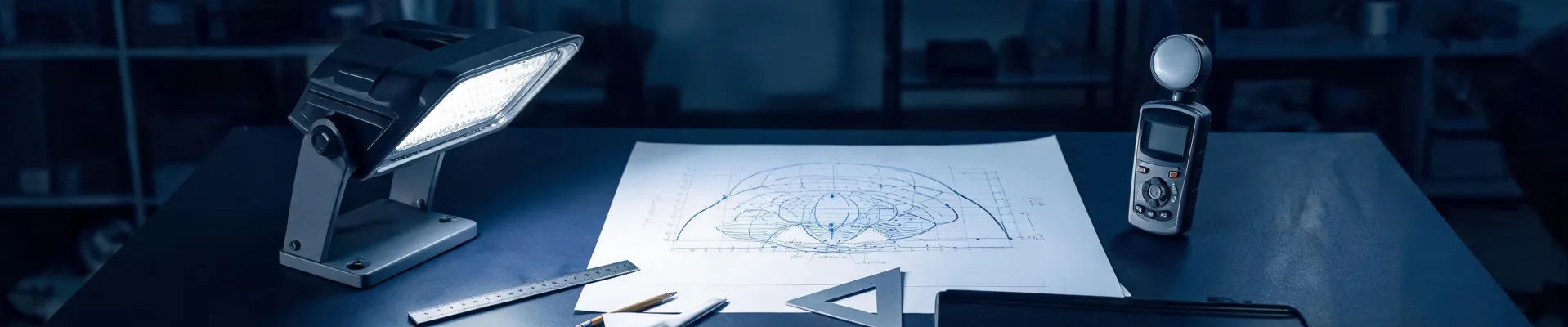
You need the IES file — the raw photometric data based on LM-79/LM-80 testing. Not a screenshot, not a rendering, not a "representative" report from a similar fixture. The actual file.
Then check three things:
- Footcandles at field level, not at the fixture. This is what the athlete — or the TV camera — actually experiences.
- Uniformity ratio. For sports lighting, you're typically aiming for at least 2:1, and many specifiers push for better. Parking lot ratios like 10:1 won't cut it.
- L70 lifespan — and how it's calculated. LM-80 data is the raw input; TM-21 projections are the methodology. Make sure both are documented.
Speed, quality, price. Pick two. I've learned to pick quality when it comes to photometric performance.
Story: a vendor once presented a "high-output" flood light with impressive lumen numbers. The IES file told a different story — a narrow peak with harsh hot spots and dark falloff beyond the center. On a tennis court, the uniformity would have been an argument. Not ideal, but workable if we'd adjusted the layout. We walked away.
Step 3: Calculate Total Cost of Ownership, Not Unit Price
Look, I'm all for competitive pricing. But if you're lighting a field, fixture cost is maybe 30–40% of the lifecycle cost. Energy and maintenance take the rest.
Use this as your comparison baseline:
Total cost = fixture price + installation + (system watts × operating hours × electricity rate × system life) + maintenance labor + replacement fixtures
Two fixtures can draw the same watts and deliver very different maintained footcandles. If fixture A converts energy to useful light 20% more efficiently, it's effectively cheaper over ten years — even at 10% higher upfront cost.
When I compared eight vendors over three months using our TCO spreadsheet, the cheapest upfront option ended up costing about $1,200 more over a five-year horizon once we factored in maintenance and energy. The "cheap" option resulted in exactly the kind of redo you don't want on a sports installation.
Step 4: Outdoor Lighting Private Label — Know What You're Signing
If you're buying outdoor lighting private label, the questions change. You're not just buying a fixture; you're buying the right to put your name on it.
Ask for:
- UL listing under your label. Your company name on the listing, not just a "private label option" that's still filed under the manufacturer.
- Labeling requirements. Your name, model number, and required safety markings on the physical label. Get this in writing. Get a sample label in the approval document.
- Minimum order quantities. And whether a custom finish or branding run changes those numbers.
- Warranty responsibility. Who handles the claim when a fixture fails — you, the manufacturer, or jointly? Which one are you comfortable with?
We both said "private label" but meant different things. Discovered this when the first batch arrived with the manufacturer's name on the label instead of ours. Relabeling 200 fixtures is not a fun afternoon.
The most frustrating part: it wasn't malicious. We just never put the labeling spec in the contract. You'd think it's obvious, but assumptions in procurement are expensive.
If you're looking for a manufacturer that handles private label cleanly, RAB is one of the few that openly supports OEM/private label for outdoor lighting without hiding it on page twelve of the catalog. Their compliance documentation stays intact under a private label, which is the whole ballgame.
Step 5: Lead Times and Delivery Guarantees — Certainty Is Worth Paying For
In March 2024, we paid a 25% premium for a guaranteed delivery date on a batch of area lights. The alternative was missing a scheduled grand opening — a $15,000 event.
Was it worth it? Yes. Not because we enjoyed paying the premium, but because the cost of missing the deadline was far larger than the rush fee.
Here's what six years of invoice tracking has taught me: uncertainty has a price. When a vendor says "should be there in 4–6 weeks," that "should" is doing a lot of work. In a time-critical project, "probably on time" is the biggest risk in the room.
Before signing, get:
- Exact production lead time in working days, not vague "weeks."
- Shipping method and transit estimate, and whether it's a project-specific rate or a standard quote.
- Consequences for late delivery — credit terms, expediting obligations, or at minimum a written commitment with a named contact.
I've never fully understood why rush premiums vary so wildly between manufacturers. It seems more art than science. But after getting burned twice by "probably on time" promises, we now budget for certainty when the deadline matters.
Step 6: Read the Warranty — The Exclusions Are the Story
Five-year warranty. Sounds solid, right?
Then check the fine print:
- Does it cover labor for replacement, or just the fixture itself?
- Is the claim process actually documented? After tracking 14 orders in our procurement system, I noticed that warranties with back-and-forth claim processes tend to go unfiled. That's a hidden cost.
- Are there conditions around surge protection? Many outdoor LED warranties are void if the fixture lacks documented surge protection.
- Is it a limited warranty with exclusions for moisture ingress or salt-spray damage? For coastal sports sites, this is make-or-break.
We implemented a policy after the second rejected warranty claim: every outdoor order includes a surge protection spec, and every claim goes through a pre-check before submission. Rejections dropped by about half.
Step 7: Ask for References — and Call Them
Certifications tell you what the fixture should do. References tell you what the manufacturer actually does.
Ask for three projects from the last two years, ideally in a similar sport or application. Then ask:
- Did the delivery date match the promised lead time?
- How were issues handled after installation?
- Any surprises in on-site photometric performance?
"Not ideal, but workable" — I've heard that phrase twice from references, and both times it masked an annoying recurring issue. If the answer isn't straightforward, dig.
Common Mistakes I've Seen (and Made)
1. Comparing prices without comparing footcandles. You're not buying watts. You're buying maintained light on the surface.
2. Assuming "compliant" means "compliant with your application." A fixture can be UL listed, FCC compliant, and still wrong for your rebate program or jurisdiction. Check the specific requirements, then check them against the listing database.
3. Skipping surge protection conversations. Sports lighting poles are tall, exposed, and expensive to service. A surge protection device is a rounding error compared to the cost of sending a crew up a sixty-foot pole to replace a driver.
4. Waiting until late in the project to think about lead times. That 25% rush premium is someone else's price for your urgency. If the schedule is tight, ask about lead time in the first call, not the last.
Price Context (as of January 2025)
For reference, publicly listed prices for specification-grade LED sports floodlights in the 400–600W range from major North American manufacturers generally start around $800–$1,200 per fixture and rise from there depending on optics, controls, and certification package. These are list prices — actual quotes vary significantly by volume and project scope. Always verify current rates before budgeting.
That's the checklist. Seven steps, one underlying rule: verify before you commit. The same logic applies whether you're comparing RAB Lighting ceiling light options for a facility or evaluating sports lighting manufacturers for a field — compliance first, photometrics second, TCO third, and everything else follows.
If you're evaluating manufacturers right now, use this as your starting point. Print it, put it next to your vendor list, and check the boxes in order. Worse than expected is a terrible thing to discover after the purchase order is signed.

Clara Whitmore is a lighting photometry and LED source analyst specializing in bulbs, tubes, strips, panels, and integrated luminaires. She interprets IES LM-79 measurements and TM-30 color rendition data through luminous flux, efficacy, intensity distribution, CCT, chromaticity, fidelity, and gamut metrics. She writes evidence-led comparisons for specifiers selecting source formats and luminaires for commercial interiors, industrial spaces, or horticultural systems where measured optical and color performance matter.