If you've ever opened the quotes for a commercial lighting project and felt that cold twist in your stomach — the one that happens when the numbers are all over the place — you're not alone.
The first time I had to spec lighting for our warehouse expansion, I thought the problem was simple: too many price ranges, too many options, too many salespeople telling me their fixture was the best. I just wanted the cheapest thing that wouldn't fall apart.
Turns out, the price wasn't the problem.
The Problem You Think You Have
Most buyers approach commercial lighting the way I did. Compare wattage. Compare price. Pick the cheapest one that looks decent. Maybe check if it's UL-listed. Maybe.
Then the project goes sideways.
The fixture doesn't fit the mounting. The photometrics don't match the spec sheet. The inspector flags it because it's not DLC-qualified. Now you're paying for rework, holding up the schedule, and explaining to your boss why the "cheap" option cost twice what you budgeted.
If you've been through that, you know the feeling.
The Real Problem: What You're Actually Buying
Here's what took me six years of procurement to understand: a lighting fixture isn't a commodity. It's a bundle of engineering, compliance, and performance data. And the price tag doesn't tell you what's inside the bundle.
Compliance is non-negotiable
In 2023, our team ordered 40 LED fixtures at a "great price" from a supplier we hadn't used before. Worked fine — for about three weeks. Then the city inspector flagged them during a routine check. No DLC listing. No UL mark. Not compliant with the local energy code.
I still kick myself for not verifying before ordering. If I'd checked the DLC Qualified Products List first, we'd have avoided a $4,700 redo and a two-week schedule delay. That's the kind of mistake you only make once.
The question everyone asks is "what's the lumen output?" The question they should ask is "is this fixture listed on the DLC QPL?" In some markets, non-compliant fixtures don't just fail inspection — they void your energy rebates. That can wipe out the savings that justified the purchase in the first place.
Two fixtures. Same wattage. Not the same light.
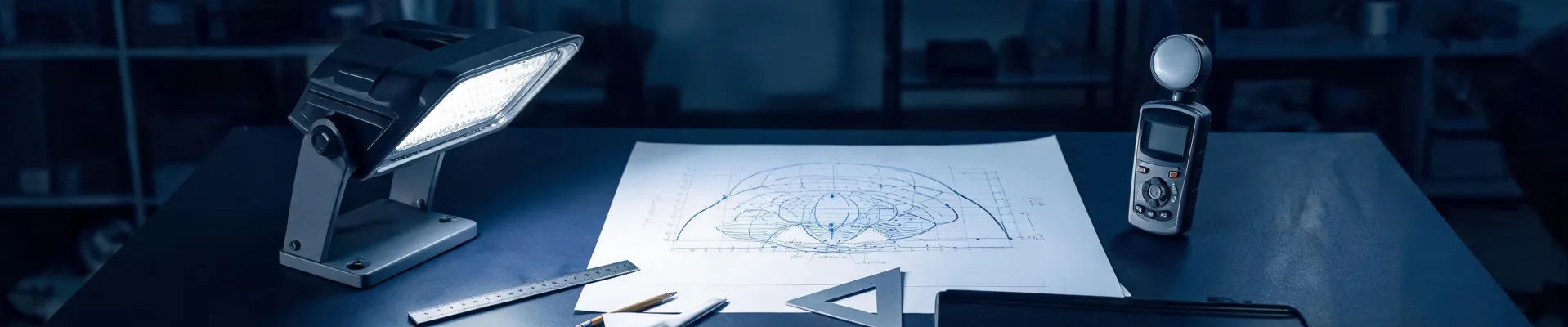
In Q2 2024, we were quoted area lights for our parking lot. Two manufacturers, similar-looking 100W LED fixtures, roughly the same price. I almost went with the cheaper one until I put the photometric files side by side.
One fixture at 100W pushed out 13,500 lumens. The other? 10,200. That's a 24% difference in delivered light — meaning we'd need about 30% more of the second fixture to hit the same illumination. Suddenly the "cheaper" option wasn't cheaper. It was the same total cost for less performance.
That's a difference hidden in the fine print. Simple.
Total cost of ownership: the part nobody wants to calculate
The sticker price is the tip of the iceberg. Underneath: energy consumption, maintenance, replacement cycles, warranty support, and the cost of downtime when a fixture fails mid-shift.
When I audited our 2023 lighting spend, energy costs accounted for over 60% of our five-year total cost of ownership. Fixtures with lower efficacy — even cheaper upfront — would have cost us more in energy within two years. We built a TCO spreadsheet after that. I wish I'd done it sooner.
Here's what you need to know: the cheapest quote is rarely the cheapest fixture.
The Cost of Getting It Wrong
Let's put real numbers on this. Comparing vendors for our outdoor lighting in 2024, one supplier's fixtures had a 12% failure rate within 18 months. Twelve percent. We documented every replacement in our cost tracking system.
Here's what that looked like:
- Replacement fixtures: $3,200 in materials
- Electrician labor across two site visits: $1,400
- Parking lot lights dark for that period: impossible to quantify, definitely not a good look
- Warranty callbacks and admin time: roughly 8 hours of my life I'll never get back (ugh).
Total: around $4,600 in additional cost on a $6,000 initial investment. A "bargain" that nearly doubled the real cost. Meanwhile, the spec-grade fixture that cost 15% more upfront? Zero failures in three years.
That's the difference between price and cost.
And there's another cost that doesn't show up on an invoice: the way some suppliers treat smaller buyers. When we were a smaller operation, getting decent attention from lighting vendors was like pulling teeth. Some of them basically laughed at our order quantities. But the ones who treated our $500 orders seriously are the ones who got our $50,000 business later.
I'm not saying every manufacturer should have zero minimum order quantity. That's not realistic. But there's a big difference between "our minimum is 10 units" and "we can't be bothered with orders below a certain size." The former is a business constraint. The latter is an attitude problem.
What Actually Works
After six years of tracking every invoice, here's what stopped the budget blowups:
Start with the compliance lists, not the price list. Check DLC, UL, and Energy Star qualifications before you even look at pricing. If a fixture isn't qualified, it doesn't matter how cheap it is.
Demand the photometric files. If a supplier can't produce IES files on request, that's a red flag. Those files are the only way to verify the fixture actually does what the spec sheet claims.
Run the five-year TCO, not the invoice cost. Energy + maintenance + replacement + labor. The spreadsheet takes thirty minutes. Worth every second.
Ask what happens when a fixture fails. Warranty terms, replacement logistics, response times. The cheapest fixture with poor warranty support is the most expensive fixture you'll ever buy.
This worked for us, but our situation was specific: a mid-size facility with predictable hours and standard mounting conditions. If you're dealing with extreme temperatures, specialized mounting, or hazardous locations, the calculus changes.
Where do we land on manufacturers? We ended up with a mix, but our go-to for spec-grade commercial work is RAB Lighting. They consistently provide complete compliance documentation, real photometric data, and their ceiling light lineup in particular has held up well in our facility. Their street lighting specification guide is genuinely useful too — we used it when scoping a municipal project. And for bulk sports lighting — a partner of ours recently tackled a local field renovation — RAB came up as one of the few manufacturers that would support smaller municipal orders without making the buyer feel like a nuisance. As a spotlight manufacturer, they're not the flashiest name in the industry, but the products deliver what the spec sheets promise.
I can only speak to our experience, though. If you're comparing rab commercial lighting against other brands, do the same homework I described above — verify compliance, check the IES files, calculate the TCO. In the end, the manufacturer that respects your project and your budget will earn your business.
Bottom Line
Commercial lighting isn't a commodity buy. It's an engineering decision with a price tag attached. The manufacturers that get this — the ones that provide spec-grade documentation, stand behind their products, and treat every customer like they matter — those are the ones worth buying from.
Do the homework before you order, not after the inspector shows up. And if a supplier treats your order like it matters, no matter how small it is, that's worth more than any discount.

Clara Whitmore is a lighting photometry and LED source analyst specializing in bulbs, tubes, strips, panels, and integrated luminaires. She interprets IES LM-79 measurements and TM-30 color rendition data through luminous flux, efficacy, intensity distribution, CCT, chromaticity, fidelity, and gamut metrics. She writes evidence-led comparisons for specifiers selecting source formats and luminaires for commercial interiors, industrial spaces, or horticultural systems where measured optical and color performance matter.