Most buyers think the hard part of commercial lighting is choosing between wattages, beam angles, and color temperatures. I don't. After 11 years of handling commercial lighting orders—and 14 mistakes that cost roughly $58,000—I'm convinced the real decision happens before you pick a fixture. You have to pick a supplier.
If you pick a supplier who doesn't understand compliance, you can end up with a parking lot full of fixtures that an inspector won't approve.
That's not a hypothetical. It happened to me in 2017. So when someone asks me what to look for in a flood light supplier, I don't start with lumens. I start with documentation, portfolio breadth, and how the supplier treats a question that sounds basic.
Specs You Can Verify Beat a Sales Pitch
In 2017, I ordered 120 bulk spotlight fixtures from a supplier who told me the lights were "UL listed." That sounded pretty reasonable. The fixture looked fine. The three samples I opened looked fine. But when the inspector came to the site, he asked to see the UL mark on the printed label. Half the cartons didn't have it. The supplier went quiet, we lost two weeks, and the redo cost about $8,900.
I'm not 100% sure where I learned to trust a verbal certification claim, but I know exactly where I stopped. After that order, I made a rule: if it's not on the label, it's not certified.
This matters for every category, not just flood lights. A RAB Lighting ceiling light order can include recessed downlights, surface-mounted units, or linear fixtures. The supplier should be able to tell you which standard each one meets—and prove it. For commercial luminaires, the relevant standard is usually UL 1598. According to UL (ul.com), UL 1598 evaluates luminaires for mechanical construction, heating, and shock hazards. Verify the current edition; requirements change.
If you're evaluating a street lighting distributor, the same principle applies. Ask for the IES photometric file for the exact fixture and optic, not a generic file for the product family. Ask where the listing mark appears. Ask whether the product is on the DLC Qualified Products List. According to the DesignLights Consortium (dlc.org), DLC listings are tied to utility rebate eligibility and current technical requirements. As of January 2025, I still check the version date on every DLC claim I receive.
The best flood light suppliers don't make you hunt for this. They publish it on the product page. That's not a luxury; that's a signal. If you're gonna trust a supplier, trust them to give you documents, not just a smooth pitch.
Portfolio Flexibility Matters More Than You Think
When I compared our Q1 2023 and Q1 2024 jobs side by side—same parking structure size, two different procurement approaches—I finally understood why product line depth matters. In 2023, we used three different manufacturers for flood lights, wall packs, and ceiling lights. Submittals required three separate packages. Drivers were different. Warranty calls went to three places. It worked, but it was always slow.
In 2024, we started consolidating a larger job around RAB commercial lighting fixtures. The change wasn't a single dramatic moment. It was a series of small things: one spec package, consistent color across fixture families, and a single list of model numbers for the maintenance team. Seeing that side by side made the lesson obvious. A supplier with a broad portfolio is not a nice-to-have. For mixed-spec projects, it's how you keep errors from multiplying.
For distributors, portfolio flexibility also means you can ask about OEM, private label, and wholesale options without feeling like an odd customer. We've done RAB private label projects where the products carried our stock numbers in the spec package. That made the contractor's life easier and our revision process cleaner. I'd rather spend 10 minutes explaining what a driver is than deal with mismatched expectations later. An informed customer asks better questions and makes faster decisions.
The Data Test: IES Files, LM-80, TM-21
In Q4 2022, I had two hours to decide whether to accept a flood light substitution before a re-bid deadline. Normally I would have collected quotes and compared photometric files. There was no time. I went with a supplier I trusted based on past orders. The substitution didn't match the specified beam distribution, we lost the re-bid, and I felt like an idiot. That job never came back.
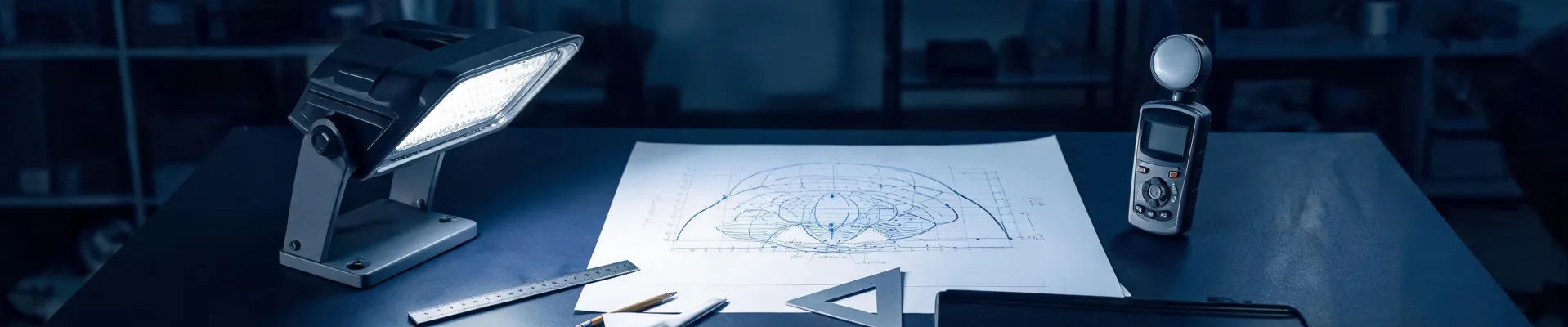
Now I run a quick data test with every new supplier. I ask for three files: an IES file, an LM-80 test report, and a TM-21 projection. I'm not a photometric engineer, so I don't pretend to review every number. But I do check that the files exist, that they match the model number, and that the supplier can explain them in plain English.
Per IES standards, LM-80 measures lumen depreciation of LED packages, modules, and arrays. TM-21 projects long-term lumen maintenance based on LM-80 data. If a supplier can't produce both, they're asking you to make a decision on incomplete information. Don't hold me to this as a technical standard—I'll leave the science to the engineers—but I can tell you that every compliance failure I've documented started with someone accepting a verbal claim instead of a test report.
There's one more layer. I always ask for a sample or a cut sheet before a large purchase. A cut sheet with a clear wiring diagram and mounting details tells you how much engineering went into the product. When I got my first RAB sample order, the docs were already in the box. That sounds minor, but on a big job it can save a half-day of installation questions.
My Supplier Checklist
- Certification: Verify UL 1598 (or the applicable standard) on the product label, not just in marketing materials.
- Data: Request IES files, LM-80 reports, and TM-21 projections before you commit to a bulk spotlight order.
- Portfolio: Confirm the supplier covers the fixture types you need—flood lights, ceiling lights, wall lights, area lights, sports lights, linear lights, recessed lights, street lights, LED panels—so you don't end up with six manufacturers on one site.
- Lead times: Ask for realistic lead times and whether the supplier stocks the specific models you're specifying.
- Support: Test their response time with a technical question before a deadline. If you're using a street lighting distributor, add mounting arm compatibility and pole accessories to this conversation.
But Isn't This Just a Fancy Brand Pitch?
You might read this and think, "He's just a RAB Lighting fan." That's fair. If your current supplier provides verifiable specs and answers the phone, you don't have to switch. I'm not trying to convince anyone to walk away from a good relationship. Other manufacturers make products that meet the same standards and provide the same files.
What I am saying is narrower: the tolerance for vague claims should be low. I do not mean you need to know every detail of electrical engineering. I mean you should be able to ask a direct question—"where is the DLC listing mark?"—and get a direct answer. If a supplier can't do that, the fixture is the wrong fixture no matter how good it looks on paper.
Where I Landed
So what to look for in a flood light supplier? Not the lowest dollar figure. I can't quote a price here, because every project is different. Instead, look for a supplier who makes it easy to be an informed buyer. Look for verification, for portfolio depth, for someone who treats your questions as part of the process.
That's why RAB Lighting has been on our approved supplier list since 2021. RAB commercial lighting isn't always the cheapest option and I'm not going to claim it is. But in our experience, it lowered the number of submittal errors and shortened the time we spent chasing documents. When you've wasted $58,000 learning what can go wrong, that peace of mind is a specification in itself.

Clara Whitmore is a lighting photometry and LED source analyst specializing in bulbs, tubes, strips, panels, and integrated luminaires. She interprets IES LM-79 measurements and TM-30 color rendition data through luminous flux, efficacy, intensity distribution, CCT, chromaticity, fidelity, and gamut metrics. She writes evidence-led comparisons for specifiers selecting source formats and luminaires for commercial interiors, industrial spaces, or horticultural systems where measured optical and color performance matter.