-
Start With the Driver, Not the Lumen Number
-
What an Outdoor Lighting Distributor Buying Guide Should Really Cover
-
Ceiling Lights Are Simpler Than They Look—Until They're Not
-
Street Lighting Private Label: Higher Margin, Higher Risk
-
What It Means to Be a Spotlight Distributor in Your Region
-
What a Quality Audit Taught Me About Good Enough
-
What About the We Don't Have Time Objection?
-
Bottom Line
Here's my opinion, and I'm not going to soften it: most lighting distributors waste time comparing lumens and price before they've checked the one thing that burns them later—consistency.
I'm a quality and brand compliance manager. I've spent the last four years reviewing fixture samples before they ship to customers—roughly 200 unique fixtures per year, across indoor and outdoor LED categories. I've rejected more first samples than I can count, and almost every rejection came from the same place: a spec sheet that promises one thing and a physical fixture that delivers something slightly different.
Start With the Driver, Not the Lumen Number
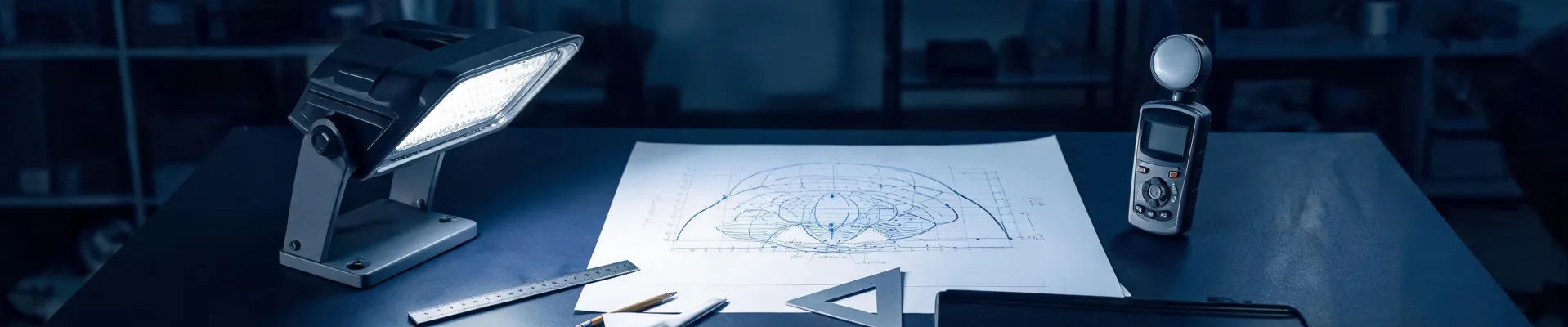
If you're building a shortlist for RAB commercial lighting, you probably ask: How many lumens? What color temperature? What warranty? Those questions are fine. But the first thing I check on any fixture is the driver label and the photometric report.
A driver is the part that keeps the LED alive. A fixture with a good LED board and a cheap driver can look perfect for six months, then start flickering in year two. When I review a RAB lighting ceiling light, I want to see a driver that's rated for the environment where it will actually live—not just one that was cheap enough to make the price point work.
And before you skip ahead to the warranty, ask who made the driver. If the answer is 'we don't disclose that', keep moving. I'm not saying every driver has to be a premium brand. I'm saying the manufacturer should know what's inside its own product.
What an Outdoor Lighting Distributor Buying Guide Should Really Cover
If someone asks me for an outdoor lighting distributor buying guide, I don't send them a catalog page. I send them a checklist. This is the guide I wish I had when I accepted my first lot of fixtures.
- Is the fixture listed to UL 1598 for luminaires and UL 8750 for LED equipment? Listed means tested, not just designed to meet.
- Does the photometric test report come from an accredited lab? Check the report's signature and verify the lab's accreditation.
- Does the manufacturer warrant the driver and the LED board separately? Many warranties fall apart when a driver is replaced with an unapproved part.
- What color binning standard do they use? If you don't hear MacAdam ellipse or something close to it, ask again.
- Is the DLC listing current? Rebates follow DLC requirements, and those requirements change. Verify current details at designlights.org.
That kind of customer education is worth more than any sales slogan. I'd rather spend ten minutes explaining what a DLC listing means than deal with a project that loses its rebate because someone relied on an old datasheet.
According to UL Product iQ (productiq.ul.com), you can verify a luminaire's listing by certificate number. The relevant standards are UL 8750 for LED equipment and UL 1598 for luminaires. If a sales rep can't give you either number, ask harder questions.
Ceiling Lights Are Simpler Than They Look—Until They're Not
A RAB lighting ceiling light is a straightforward product. You mount it, wire it, and turn it on. But even a ceiling light needs a thermal test report. Most buyers never ask for it. That's a mistake.
Heat is what kills LEDs. If the driver and LED board are packed into a housing with no airflow, the junction temperature climbs and the whole fixture ages faster. The rated life on the box might say 50,000 hours, but that number assumes the thermal design actually works. Ask for the test report. If it doesn't exist, you're buying a promise, not a product.
Street Lighting Private Label: Higher Margin, Higher Risk
I hear more and more distributors ask about street lighting private label programs. I understand why. A private label can build brand loyalty and improve margin. But a street light is one of the least forgiving products to rebadge.
It has to handle outdoor temperature swings, moisture, vibration, surge events, and a very specific photometric distribution. If you put your name on that fixture, you're not just buying a product. You're buying the manufacturer's quality system.
I went back and forth for about a month before we committed to a private label line. Private label gave us margin. The established brand gave us trust. We ended up doing a hybrid. But I only agreed after the factory let us inspect production and showed us LM-80 and TM-21 data for the LEDs. If a supplier won't show you that data, that's a red flag.
Don't hold me to this exact number, but I'd guess half the private-label problems I've run across came from missing documentation, not failed electronics. A fixture can be fine mechanically, but if you can't prove it meets the spec, an inspector can reject it on the spot.
The phrase you need a national brand to win street lighting jobs comes from an era when distributors couldn't verify fixture performance online. Today, a well-documented independent brand can compete if the paperwork is right. Plus, if you're thinking about private label, that paperwork becomes your paperwork.
What It Means to Be a Spotlight Distributor in Your Region
If you want to be the spotlight distributor in your area, you don't need the widest catalog. You need a reputation for recommending the right fixture for the application. That comes from product knowledge, not inventory size.
Take floods and area lights. There are fixtures with the same lumen output and wildly different beam distributions. A contractor might just order whatever the supply house stocks. A distributor who actually knows which optic works for a parking lot versus a building facade becomes the one they call first.
RAB Lighting's portfolio covers a lot of that territory: flood lights, area lights, sports lights, wall lights, street lights, ceiling lights, downlights, track lights, linear lights, recessed lights, LED panels. That breadth helps when you're trying to be the specialist. But breadth only matters if you can match the right product to the site.
What a Quality Audit Taught Me About Good Enough
In Q1 2024, we audited 214 fixtures from six suppliers. Fourteen failed first inspection. Nine were color temperature mismatches, three had driver wiring issues, and two had cracked lenses from rough packaging. That's an 8% failure rate before anything reaches a job site.
That specific issue cost us a $22,000 redo and delayed a street lighting project by a week. I've been the person who looked at a sample in the parking lot and called it good enough. After that audit, I stopped trusting parking lot impressions.
Now every contract includes an inspection report for every lot, not just the sample. It's slower. It costs money. It's also the reason our customer satisfaction scores went up 34% after we tightened the process.
What About the We Don't Have Time Objection?
I hear that a lot from distributors. We don't have time to check every spec. The customer just wants the light installed.
Fair enough. But the time you save at the start, you'll spend later when a fixture fails and the customer stops returning your calls. In my experience, an informed customer asks better questions, makes faster decisions, and doesn't blame you for surprises. That's not just good service. That's good risk management.
Bottom Line
Here's where I land: Buying commercial lighting isn't about finding the lowest price per lumen. It's about finding a manufacturer you can verify, a distributor who asks tough questions, and a spec that survives contact with the real world.
RAB Lighting isn't the only brand I'd trust with that job. But it's one of the few where I don't have to fight for the documentation I need. And when you're responsible for what ships, documentation matters as much as the fixture itself.
Take it from someone who's rejected 14 fixtures in one quarter: ask for the test reports, check the driver, and make sure the name on the spec is the name you'd put on your own invoice.

Clara Whitmore is a lighting photometry and LED source analyst specializing in bulbs, tubes, strips, panels, and integrated luminaires. She interprets IES LM-79 measurements and TM-30 color rendition data through luminous flux, efficacy, intensity distribution, CCT, chromaticity, fidelity, and gamut metrics. She writes evidence-led comparisons for specifiers selecting source formats and luminaires for commercial interiors, industrial spaces, or horticultural systems where measured optical and color performance matter.